Rome Travel Guide

Rome Architecture, History, Art, Museums, Galleries, Fashion, Music, Photos, Walking and Hiking Itineraries, Neighborhoods, News and Social Commentary, Politics, Things to Do in Rome and Environs

Tuesday, June 28, 2011

Teens Gather: Park of the Aqueducts

Teenagers get together everywhere.  But in Rome they often do so in remarkable places and settings that give these meetings a grace they wouldn't have if they were to take place outside, say, a Wilson Farms store.

We recently published a photo of one such gathering, at the Museo della Civilta', amid the enormous columns of Mussolini's EUR.  In this one, we're at Parco degli Aquedotti  (Park of the Aqueducts), with our teens displayed along one of the park's aqueducts, low here because it's going to ground at this point (toward right), soon to be fully underground. 

The name of this aqueduct is Acqua Felice.  Though not of ancient origin, it's old enough (Hillary), constructed in the late 16th century under Pope Sixtus V.  The Parco is fully described in Itinerary 1 in Rome the Second Time, along with a good story about Sixtus (not the nicest man) and Acqua Felice, which didn't work right when it was turned on.  Those teens in the photo probably don't know the story, but they're making good use of the structure, which still carries water to Rome.
Bill

And here's a link to a Google Maps version of Itinerary 1's map: 
http://maps.google.com/maps/ms?ie=UTF8&hq=&hnear=Rome,+Lazio,+Italy&msa=0&msid=115234173574934358486.00048bfd318d41d8b7cb1&z=15  Google Maps versions of all 16  maps in the Book (accessible by hyperlinks in the ebook versions) are in a document at right (under the Book Updates document), also available by this link:  http://www.scribd.com/doc/56172132/Google-Maps-Versions-to-Rome-the-Second-Time-book-maps
Dianne

Friday, June 24, 2011

Italy vs. Slovakia, 2010


Headed for a hike in the Lepini moutains southeast of Rome, we came across this apartment building, festooned with Italian flags to celebrate Italy's presence on the World Cup stage, on the outskirts of Rome in June, 2010.  We hadn't seen anything quite like it, and we turned the scooter around to capture the image. 

Almost a year later, as we're showing it to our readers, it has another meaning than the celebratory one on its surface.  It was taken in the morning on June 24.  Just hours later the Azzurri (the Blues) would lose a crucial game to upstart Slovakia in the closing minutes--the final score was 3-2---and Italy would be eliminated in the "group" stage of the competition, before the Round of 16 in which the Italian team had been expected to participate--as usual.  It was a crushing and humiliating defeat for a proud soccer power with a distinguished history--and, we have no doubt, a bitter disappointment for the residents of this building.     Bill

Tuesday, June 21, 2011

Graffiti: the Good, the Bad, and the Ugly. MOCA, and Rome

We recently spent some time in the pathbreaking exhibition of graffiti at the Museum of Contemporary Art (MOCA) in Los Angeles.  It's enormous and powerful; not to be missed.  But we were surprised that Rome was not featured, or even included.  The exhibit focuses on what it describes as "key cities"--New York, San Francisco, Los Angeles, Sao Paolo, and Paris--cities where "a unique visual language or attitude has evolved." 

We can't claim that Rome has been the site of such a "unique visual language or attitude"; we just don't know enough about the art form.  That said, we've never seen or heard of anything like the giant graffiti mural/posters, applied like wallpaper to buildings in the quartiere of Garbatella last spring.  What we do know, having spent some time in New York City and Los Angeles as well as Rome, is that Rome seems to have MORE graffiti of all levels--the good, the bad, and the ugly--than either of those cities.  For good or bad--or ugly--it's everywhere. 

We've posted several times about the good stuff, and we'll leave it others with more knowledge of the international scene to make Rome's claim to inclusion as a great center of graffiti art. 

Our purpose here is limited.  We're offering a "typical" Roman wall on the bad and ugly end of the scale.  This one is located in the suburb of Centocelle, about 20 minutes from the Center.  There are hundreds, perhaps thousands of such walls in Rome, crammed with tags (signatures of graffiti artists), miscellaneous markings and scraps of posters old and new.  Some of the academics writing about graffiti argue that however ugly the ugly stuff is, it's essential--like a drummer learning the rudiments, a pianist practicing scales, or a skater stumbling through an early set of figures.  You can't have the good--graffiti as art--without first having the ugly, then the bad.  We're not sure that's true, but we've come to appreciate the energy and chaotic power of "ugly" walls such as this one. 

And maybe next time Rome will make the cut. 
Bill

Thursday, June 16, 2011

RST Top 40. #3: Via Tasso


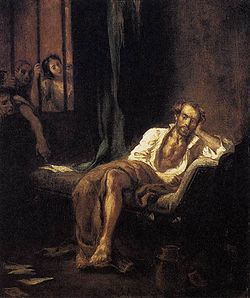
The poet Tasso in a mental institution in Ferrara.
Painting by Eugene Delacroix. 
For knowledgeable Romans, via Tasso has two meanings--two, that is, besides the obvious: an unimposing street that runs northwest for 5 blocks from behind the Scala Santa in front of San Giovanni in Laterano.  One of the other meanings, of which we were made aware only recently, by way of Goethe's many references, is the brilliant, influential 16th-century poet Torquato Tasso.  Born in Sorrento, Tasso spent his most productive (and most frustrating) years in Ferrara, where he wrote the lyrical epic Gerusalemme Liberata (1574) and, two years later, was incarcerated in a mental institution, perhaps for conduct that was only intemperate.  He died in Rome in 1595,  a few days before he was to receive from the Pope the "crown of laurels" as the king of poets.

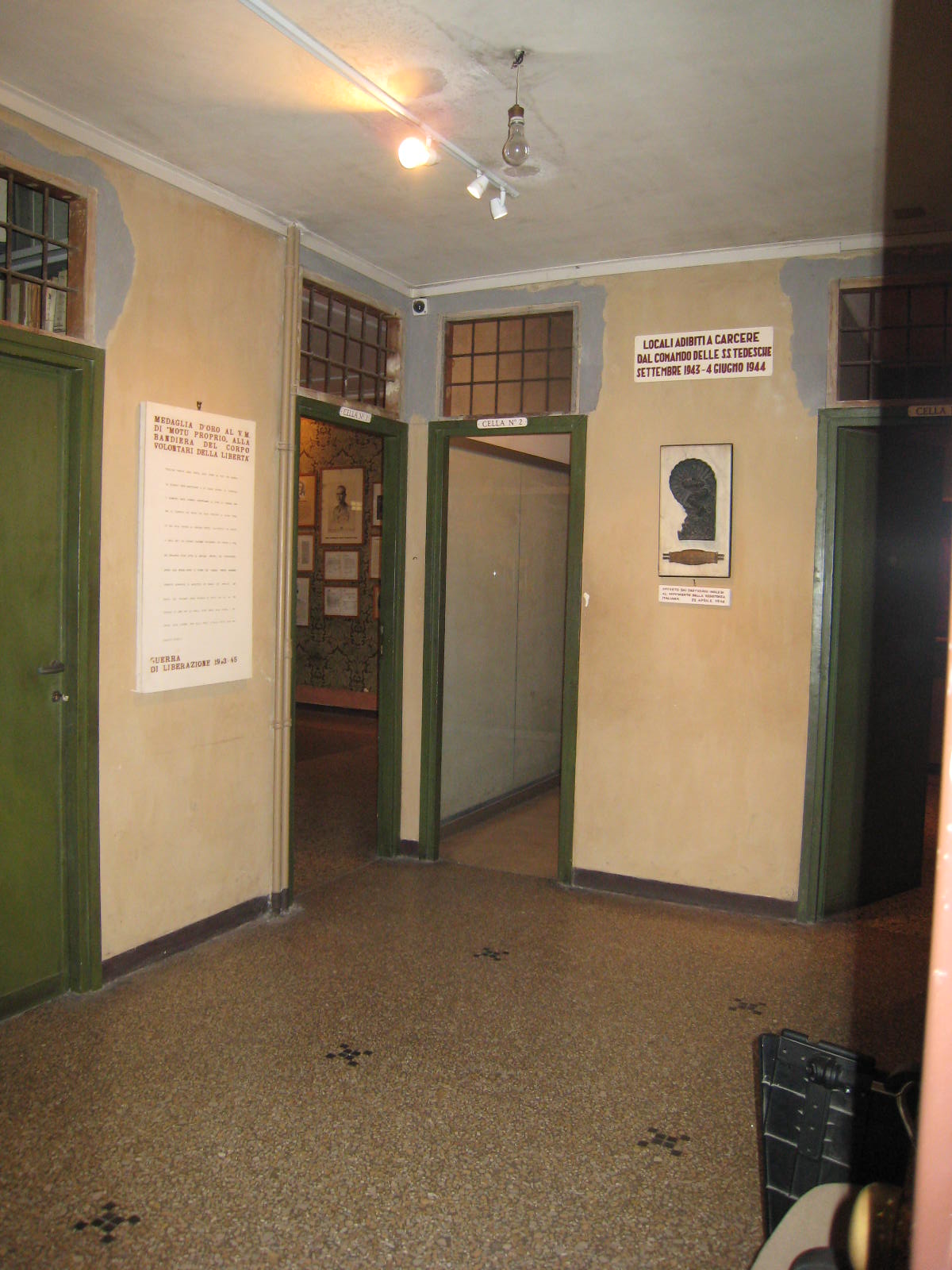
The other meaning of via Tasso is starkly different: the Nazis' political torture prison.  The official name is the Historical Museum of the Liberation--it's open and you can visit-- but what happened here at via Tasso 145 was hardly liberating.  Between September 1943, when the Germans occupied Rome, and June 1944, when the city was liberated by allied armies, the prison on via Tasso--now often called simply "via Tasso"--was the scene of torture, abuse, and death for hundreds of prisoners, among them Jews, partisans, and the innocent.  Late in March, 1944, all the prisoners housed at via Tasso were removed and summarily executed at the Fosse Ardeatine, caves just outside the city.

Via Tasso is a haunting place to visit.  Many of the rooms of the prison now hold exhibits and documents, some of which we have translated from the Italian in Rome the Second Time.  But some of the cells are still there, and there, especially, one can see--and feel--the anguish of those held here.  A reader of a February 5 post on the Fosse Ardeatine sent us these lines (the translation is the reader's, too), scratched by a prisoner into the wall of his cell, returning us to the man Tasso, to his experience as a prisoner, and to the relationship of poetry to the human spirit.

L'anima a Dio
La vita al re
Il cuore alla donna
L'onore per me

My soul to God
My life to the king
My heart to my wife
My honour to myself


Bill

Saturday, June 11, 2011

Bicycling in Rome's Countryside: Circling Lago di Bracciano for Fun and Food


Peggy and John Preissing enjoying a gelato
on the boardwalk at Anguillara.

RST does not bicycle. So we asked John Preissing, whose bicycle has seen most of Rome’s streets and much of its hinterland, to write something for us on the sport as it is practiced in Rome and environs. In this post, John joins his wife, Peggy, and daughter Kathleen on an excursion around Lago di Bracciano, perhaps best known for its eel population. Both veterans of the Peace Corps, John and Peggy have lived in Rome (Garbatella) for three years. Peggy teaches first grade at Ambrit, an international school in Rome with a diverse student body. Kathleen has just finished her sophomore year at the Rome-based John Cabot University, located in Trastevere. John works at the Food and Agriculture Organization (FAO) of the United Nations, where his specialty is the improvement of agriculture research and extension programs in developing countries. He’s written on bicycling—and local eateries—for Pedals and Forks.


Biking in and around Rome can be a serious undertaking, or as one friend has described it, foolhardy. Tragic accidents in Rome between bikes and cars occur with unfortunate frequency. Two women were killed in separate incidents over the past year. The BiciRoma bike club is a strong advocate for bikers’ rights and for improving the access and safety of bicyclists around Rome. Its President, Fausto Bonafaccia, is a tireless backer. According to him, Rome’s elected officials are only slowly coming around to the traffic, health, and energy arguments in favor of biking as opposed to seeing bikers as a nuisance. I should add that Rome’s transportation department (ATAC) has recently refocused its mission on mobility, not car transportation, and now operates the city’s free bike sharing program.

Bracciano  - the town, the castle, the lake
Once you gather your courage to ride around Rome on a bicycle it’s amazing how quickly the city opens up. In fact, one game we play is to see how long it takes someone during normal traffic to get from point A to point B in the city. Almost always the bike wins. Other than the indifferent Dutch and stylish Italians, everyone wears helmets and I would always recommend it. Additionally, a reflector on your bike, a light in the front, and something bright would be good to wear. But I do mean for this posting to be about biking and not about preparations or the fear of biking. A recent trip we took to Lago di Bracciano-- a large volcanic lake about 35 km (22 miles) northwest of the city-- highlights how lovely it is to ride in and around Rome.

The best way to get to Lago di Bracciano is via the regional train to Viterbo, taking it from the Ostiense train station. Buy a ticket for yourself and one your bike (either 3.50 Euros or the same price as your passage, whichever is cheaper). Buy your return tickets, too, because it can be hard to find a tabbacheria (the stores with a big “T” out front) near the trains in Bracciano. Regional trains, like the one to Bracciano, accept bikes every day of the week and the trains are supposed to have one carriage with bike racks. However, some trains don’t have the carriage so the bikes are in the corridors. The ride takes about 45 minutes, passing through the most intense urban and upscale suburban neighborhoods before reaching the town of Bracciano—also, of course, the name of the lake.

The town has one of the loveliest castles in the vicinity of Rome and really must be visited, either before or after the bike ride.


Getting to the lake from the station takes 10 minutes, all downhill. (There will be an uphill, but that’s for later.) An ideal place to start is at the Bracciano lakeside, heading east (counterclockwise). The lake is 36 kilometers (22.4 miles) in circumference. It is a favorite for Romans escaping the heat and the crowded beaches of the coast. In some ways, the lake’s shore culture is more blue collar than some of the seaside towns. The small lakeside town of the Bracciano lido has a string of restaurants, campgrounds, kayak rentals, and a skimpy beach of crushed rocks. It is lovely to sit out on the lakeside restaurants, but for most riders this is a place to start, not stop.


Anguillara, seen from the road to Trevignano.

An ideal thing about riding around Bracciano is that it is a relatively short ride with just two or three hills to challenge the rider. And, invariably each hill is followed by a delight. The first stretch takes about 30 minutes to reach Anguillara. This 10 km (6 mile) portion has some great vistas - and, oddly, a national air force museum - until it descends to the seaside town of Anguillara, made famous by films directed by Fellini and Rossellini. It’s easy to see how Anguillara attracted Fellini, with its beautiful boardwalk and town leaning heavily towards the sea. We always stop here and enjoy the first gelato of the day. The Il Gabbiano provides great gelato artigianale (homemade) with the standard flavors but an unbeatable view.
Eels decorate an Anguillara fountain.

Historically, Anguillara was known for its fishing and, of course, eels. In spite of the actual presence of eels (eel is anguilla in Italian), historians say the town’s name is from the angle at which it juts out into the lake. Today, a number of restaurants and small resorts crowd the lakeside.

Rather than just leaving town, I’d recommend riding (more likely walking if you are like me) to the top of the town to see the outstanding views from the courtyard of the Church of Assunta. Up above the lake, Anguillara has a less spectacular residential area; many people commute from there to Rome.

Descending again, continue towards Trevignano, about 15 km (9 miles), or roughly an hour along the coastal road. There are stupendous views back towards Anguillara. About 5 km before arriving in Trevignano, a bike path emerges on the right side of the road, away from the lake. It is just in time, as the road narrows and traffic picks up. Just before entering town, pass by the piccolo San Bernadino church, built in 1452 to commemorate where the saint-in-the-making preached. The last time we passed by it was being set up for a wedding.


Squid (calamari), a favorite of Kathleen
Preissing.  Trevignano, with the
lake in the background.
 Trevignano’s downtown is the most picturesque of the three cities along the lake. With a population of 5,000 it hosts summer events, scores of restaurants, and boutique shops that are nestled in the ancient town. Trevignano also offers free bikes for use while in town and parking on the outskirts to ease traffic. We always make two stops when we are there: first to the open water-fountain troughs, similar to Rome’s nasoni, but much bigger; and second to Casina Bianca, at the far end of town and our favorite restaurant on the lake. Try the fried calamari antipasto.


After relaxing over white wine and a pasta dish it is hard to get motivated for the final 10 km leg back to Bracciano, especially since the route includes the second largest ascent of the ride. Nonetheless, passing by the small hilltop restaurant and viewpoint of Mont Rocca Romana makes it worthwhile. Upon returning to the lakeside of Bracciano, water or beverage of choice is available at the many seaside locales.

I began this post by noting that the downhill ride from the actual center of Bracciano to the lake was a breeze. It definitely is not a breeze going back up, and most people walk their bikes part of the way. Give it a try and return to the station for the afternoon trip back to the Ostiense station in Rome. For those with remaining time (and energy), consider a visit to the Odescalchi Castle (ca.1475) in Bracciano. It looms over the city and has connections to Popes, soldiers, statesmen, and celebrities (Martin Scorsese and Isabella Rossellini, and more recently Tom Cruise and Katy Holmes, were married in there). The castle itself is worth another post.

John Preissing
A PS from Dianne - An early post of ours mentions the water from Lago di Bracciano arriving via aqueduct (Acqua Paola) in Rome to much fanfare in the early 17th century, only to be declared really lousy.  And another features a photo of a building on the outskirts of Rome with yet another eel trap.


Monday, June 6, 2011

The Dogs of Rome: a Conor Fitzgerald Novel

"He's got a garage," said Blume.  "Jesus, I'd give my right arm to have one of those."   The speaker is Alec Blume, an American by birth and now, in his 40s, Chief Commissioner of Rome's police department--a high-level detective.  Earnest, determined, smart, opinionated--"I hate Sordi.  Hate his movies, hate his voice.  All that Romanaccio shit"--somewhat arrogant and ethical to a fault, Blume is at the center of Conor Fitzgerald's entertaining new (2010) crime novel, The Dogs of Rome.  The title refers not to the tiny, yappy dogs that most Romans favor, but to larger beasts trained to be nasty for the dog fights that all too many Romans enjoy and which take place, in the novel, in an abandoned warehouse off the Via della Magliana.  (In August 2001, Rome's real police discovered 7 dogs, intended for fighting, in a nomad camp off the Via della Magliana.)  Blume detests dogs, but he ends up with one--a Cane Corso, described as a dog the Romans used in battle. 

A Cane Corso.  Man's best
friend--except when he's not.
Novels are always partly invented, and that may be the case with several of Fitzgerald's references.  I could find no evidence of a Rome restaurant with the name "Mattatoio Cinque" ("Slaughterhouse 5") nor does the internet confirm the existence of De Pedris, a shop that serves exquisite pastry.  But Fitzgerald--who lives in Rome--knows his geography, and readers hungering for Rome and its environs will find in these pages references to (and comments about) the familiar (EUR), obscure (Borgata Fideni--to the north) and those in between (Corviale).  One transforming scene takes place in the quartiere of Marconi, along Via Oderisi da Gubbio, Viale Marconi, and Piazza della Radio, the latter accurately noted as a great place to park a car for the Porta Portese Sunday market.  Another dramatic scene plays out in the area between Via La Spezia, where Blume resides, and the Basilica of San Giovanni.  Blume's parents are buried in the not-too-distant Verano cemetery.  

Tourists who want to think Rome is just one gelateria after another may find distasteful Fitzgerald's conclusion that what is "eternal" about the city is its organized crime and the corruption that ripples through politics and the police force.  "For a quarter of a century," one of his characters opines, "the police have not disturbed the criminal status quo in the districts of Magliana, Tufello, Ostia, Corviale, Laurentino 38, Tor Bella Monaca, Tor de' Schiavi, Pietralata, Casalbruciato, and Centocelli."  In a previous post, we described Centocelli as charming.  We would not--and did not--say that about Corviale, though we were fascinated by the mammoth 1970s housing project by that name.  We no longer stroll, as we did only a few years ago, in the projects of Magliana. 

This writer is no great fan of detective novels; he's probably read five in a lifetime.  But I was very much taken with Dogs of Rome.  Blume is a worthy protagonist, and Fitzgerald's story has pace and drama.  Most important, there's just enough about Rome and Romans.  Of one of his characters, Fitzgerald muses:  "He considered going carefully...but there was no point.  No policeman in Rome ever pulled anyone over for reckless driving.  They considered it demeaning."  Coming from a killer, but right on. Bill

Wednesday, June 1, 2011

Michael Graves: The Rome Connection

Graves's studio at the American Academy (#9)
We've never met Michael Graves, the famous architect.  But we have had a close encounter, or so it seems, looking back fifty years into the early 1960s.  We were Stanford students then, doing the current version of the European tour: undergraduates on a "junior year abroad" (actually my sophomore year), thinking that Europe would always be dirt cheap.  Our base was Florence, but they insisted on taking us to Rome, and in the fall of 1962 we got there, astonished by the Coliseum and the Forum but also confronted with the city's excursion into modernism: Pier Luigi Nervi's Palozetto dello Sport, which had recently been completed.  We had no idea what we were seeing. 

The Portland Municipal Building (1982)
And we had no idea, of course, that we had just missed Michael Graves, who had months early departed, having spent much of 1960, 1961 and early 1962 (we arrived in the fall of that year) at the American Academy in Rome and elsewhere on the continent, absorbed in his own European tour.  He was not famous then.  He had not yet designed the Portland Municipal Building--one of the founding works of "postmodern" architecture--nor the Humana Building, nor the Denver Central Library, nor dozens of other important structures, and it would be decades before he became one of the world's foremost designers of commercial products, producing designs for Alessi (teapot, 1985), Steuben, Target, Dansk, Disney (the Swan and Dolphin hotels), and Delta Faucet (I was repairing a Delta faucet this afternoon--perhaps one that had its origins as a  Graves sketch).  While in Rome, he was already thinking about product design.

Graves, sketching in Rome, 1961.  He sold some
to tourists for $50. 
No, at the time of our near-crossing in Rome, Michael Graves was mostly an intense 28-year old full of expectations and dreams, a Harvard M.A. in Architecture (1959), and good enough to win the Rome Prize at the American Academy, but not yet really an architect--not yet really anything.  I wish we had met him then, before he became, well, "Michael Graves."  We could have shared our drawings. 

A Graves sketch of the Villa Borghese, c. 1961
It is not too much to say that Michael Graves was made in Rome, transformed by that year or two (however long it was) at the American Academy and by the tour of Italy and Europe that followed.  Nothing gets written about Michael Graves that does not emphasize that formative Rome moment, and Graves has fed the myth with his own words.  In the introduction to a recent book that recounts and fixes the architect's Rome experience with his drawings, sketches, and photographs, Graves begins right there: "The extraordinary experience of two years at the American Academy in Rome in the early-1960s transformed how I looked at the world around me.  In that rich and marvelous city, I came to understand architecture as a continuum from antiquity to the present day, and thus as a language.  I discovered new ways of seeing and analyzing both architecture and landscape.  I also developed an urgent need to record what I saw and created hundreds of photographs and drawings." 


A Graves-designed school building

Enrico del Debbio building, 1931-33
The Rome drawings that fill the early pages of Brian M. Ambroziak's Michael Graves: the Grand Tour (2005) are mostly of ancient Rome--the Coliseum, the Basilica of Maxentius, the Arch of Constantine--or of Renaissance/Baroque Rome--the Aqua Paola Fountain, Santa Maria Maggiore, Villa Borghese.  He was particularly taken with the buildings and ornamentation of Francesco Borromini.  But Rome's monumental and rationalist architectures of the 20th century were there to be seen, too, and it seems to us that some of Graves's later works draw as much on these buildings--essentially, the aesthetics of the Fascist era--as they do on earlier periods.  (See comparison in photos above).   

Graves,  the Denver Public Library
By 1967 Graves had emerged from obscurity, joining Richard Meier, Peter Eisenman, Charles Gwathmey and John Hejduk (with Philip Johnson as mentor) in The New York Five.  He was mostly a house designer in the 1970s.  1982 was a breakthrough year.  With the Humana Building in Louisville, Kentucky, the Portland Building, and two major museums, he quickly became an exemplar of the movement known as postmoderism.  He came to terms with Alessi in 1985, agreeing to design the whimsical tea kettle for 1.5% of each sale; over 2,000,000 have been sold. 

Rome transformed Graves, but that experience was iconic in a larger way, too.  By 1960, existing movements in architecture and the arts had reached a point of exhaustion.  In painting, abstract expressionists had reduced the form to an extreme of simplicity: a canvas painted in one color.  There was nothing beyond, except perhaps not to paint the canvas at all.  The rectagular glass box had done the same in architecture, showcasing a rigid and extreme modernism that suggested that the form, having been perfected, was untouchable.  They ran out of ideas in Detroit, too, desperately attaching huge, space-like fins on the new models in an awkward, failed effort to tap the future. 

Rome gave Graves--and, in the larger sense, architecture--its new direction: it would draw on the past, the collective past, on the buildings of Rome and Athens, on Egypt's pyramids, on the monumentalism of the ancients, on the towers of medieval Europe, on English furniture of the 18th century, on the fascist aesthetic, on the colors of Italy.  The past was complex and seemingly limitless and, for better or for worse, it would fuel the architectural resurgence of the late-20th century.  What Graves found in Rome was the raw material of the postmodern aesthetic experience. 

Why Graves would start thinking about designing commercial products while in Rome is less clear, but he was hardly alone in connecting the artistic and commercial.  In 1962, while Graves was wrapping up his European sojourn, Andy Warhol was having his first important solo exhibitions in Los Angeles and New York, featuring representations of Campbell's Soup cans and Coca-Cola bottles.  Graves designed products; Warhol used products to make designs.  Both understood the limits of modernism; both had a playful side; both drew on the unparalleled dynamism of American consumer culture to revitalize aesthetic forms.

There was one big difference--well, surely more than one, but one that's especially relevant here.  Warhol cared little about the past, and he had not been to Rome--at least, not that we know of.  Where Graves discovered the a glorious past that could be fashioned into the future, Warhol imagined only irrelevance.  "They call Rome 'the Eternal City,' he wrote, "because everything is old and everything is still standing.  They always say, 'Rome wasn't built in a day.'  Well, I say maybe it should have been, because the quicker you build something, the shorter a time it lasts, and the shorter a time it lasts, the sooner people have jobs again, replacing it.  Replacing it keeps people busy." 

Bill

We highly recommend Brian M. Ambroziak's lovely book, Michael Graves: Images of a Grand Tour  (New York: Princeton Architectural Press, 2005).  Foreword by Michael Graves.