Rome Travel Guide

Rome Architecture, History, Art, Museums, Galleries, Fashion, Music, Photos, Walking and Hiking Itineraries, Neighborhoods, News and Social Commentary, Politics, Things to Do in Rome and Environs

Friday, May 27, 2011

RST Top 40: #4: Campo de' Fiori at Sunrise

market stalls opening up in the Campo
Campo de’ Fiori, in the heart of old Rome, has a storied history but we are ambivalent about its present.

The large piazza is named after the meadow of flowers that once occupied the land there, now replaced with an equally colorful, bustling market place much of the day. At night, it is a lightning rod for drunken young people of all nationalities, and a scourge of much of the neighborhood.

Still, how can one not be seduced by a piazza where a church heretic was burned at the stake (see our earlier post on Giordano Bruno - and the interesting comment to that post)? Where the cry for Italy’s independence was most heartfelt (think Tahrir Square)? Where Romans once built theaters?

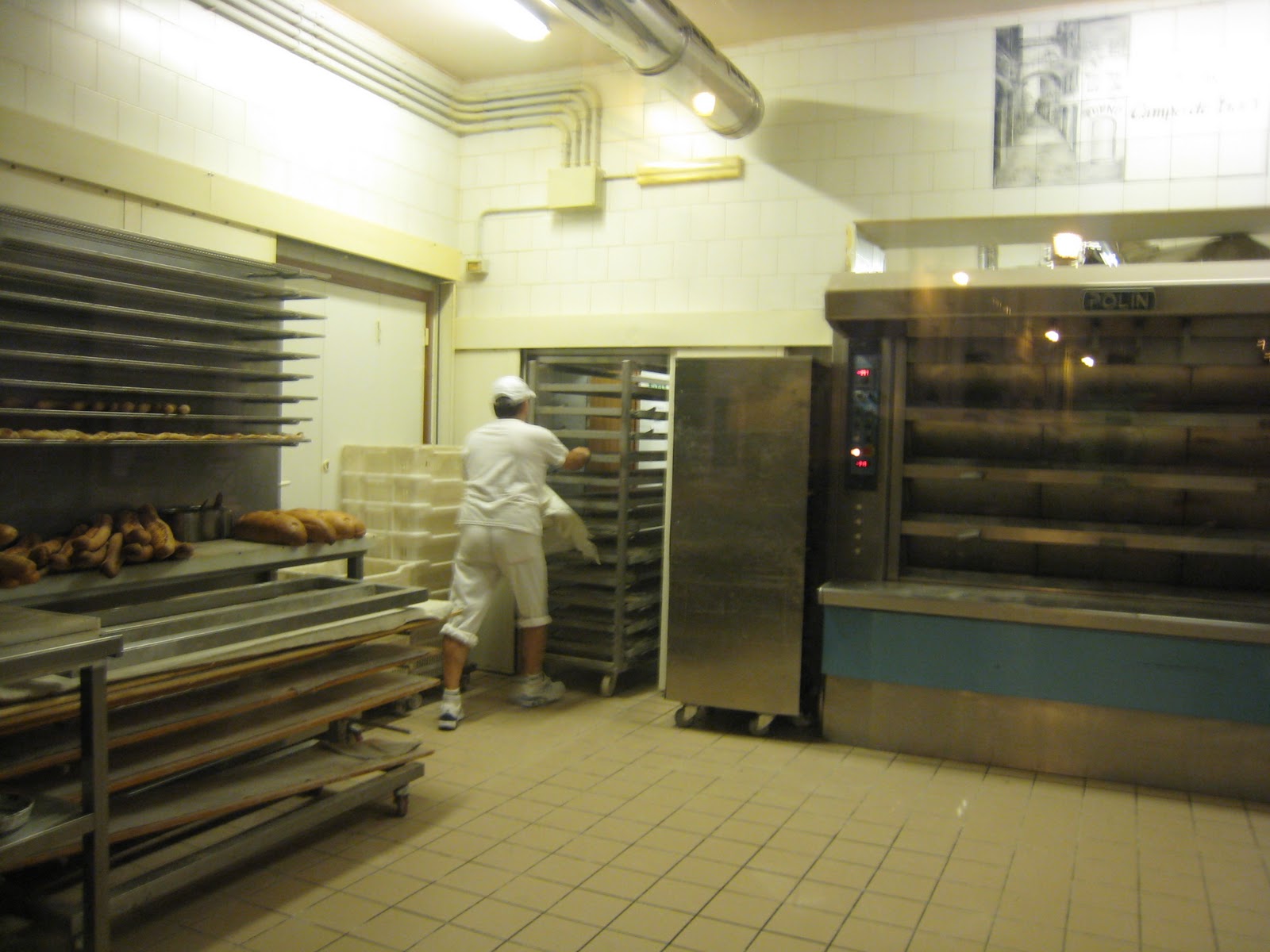
bread coming out of the ovens at 5 a.m.
For us, the magic of Campo de' Fiori was restored when we scootered into it one weekday morning at 5 a.m. – to watch the market stalls being set up, the bakery bread being readied for the ovens. One could see, smell and feel the authenticity of a true market square.

And so, Campo de’ Fiori – at 5 a.m. anyway – makes our Rome the Second Time’s Top 40 at #4.

Dianne

PS – see also the University of Washington Rome Center’s lovely view over the piazza to St. Peter's in our post, Campo di UW.

Sunday, May 22, 2011

An Artist's Life: Giorgio de Chirico's home in central Rome - home in Rome series 2

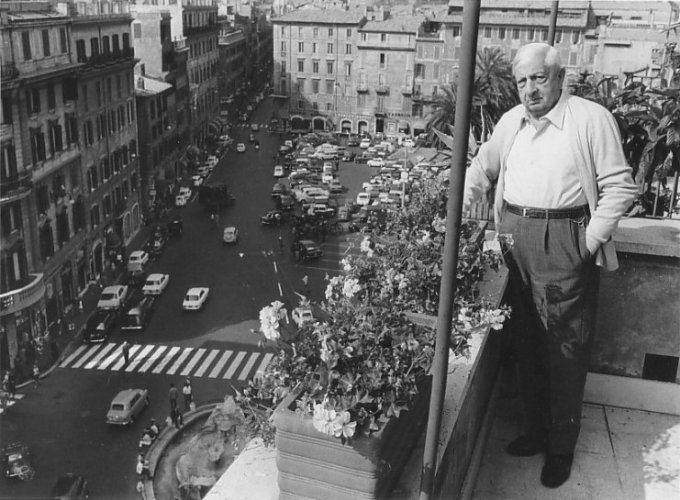
de Chirico on his terrace overlooking Piazza di Spagna
Giorgio de Chirico is without doubt Italy’s most famous 20th century artist. The style and movement he represents are referred to as “metaphysical.” And, if you have as much trouble with that as we do, we recommend you visit the to the Carlo Bilotti museum in the Villa Borghese park (#33 on our Rome the Second Time Top 40 list), AND de Chirico’s home.

De Chirico’s home is run as a museum but looks basically as he and his wife left it when he died in 1978, after living there 30 years. The place is so homey it looks completely bourgeois. One of our friends pointed out the worn leather chair parked opposite the TV – looks like he spent a lot of time there!

Visiting the artist’s home, which has his studio and many of his works, as well as inspirations for his work, is a treat. The location is easy – just off the Spanish Steps. But you must make a telephone reservation. Days and hours for tours are limited – usually a couple mornings a week - and the most recent information we have on cost was Euro 5. It’s worth the phone call, in our opinion

One of de Chirico's metaphysical paintings

It’s hard to explain de Chirico’s art, except to say that it is unique in many ways and embodies Italian figures from Roman times to the present. And we won’t even try to explain “metaphysical” as it’s used here. Just look at the paintings. You can always consult Wikipedia for more information on the artist, but we like better a blog on de Chirico that was inspired by the blogger’s visit to the home. You can also get some information from the de Chirico Foundation website, although it’s in process of being updated.

De Chirico’s home at Piazza di Spagna, 31,  is just around the corner from the Keats-Shelley museum, that is, the bedroom where Keats died. Quite a contrast – in wealth, centuries, and art. Try them both.

Dianne

Thursday, May 19, 2011

Rome the Second Time Refreshed

We just updated critical chapters of Rome the Second Time, including the chapters on food and drink.  Because entertainment venues change so frequently in Rome, one really can't ever rely on one being open  - or closed.  But we brought you as up to date as possible.  The link to the Updates is at right of the blogsite.  Originally the Updates were designed for the ebook versions of Rome the Second Time, which has over 100 hyperlinks.  But it's equally useful for the paperback users as well.

To give you a taste of the ebook versions, we provided a Google overlay of one of the book maps that appears in those versions.  This example is from Itinerary 9:  Monte Mario (from Chapter 4: "Getting Away Inside Rome").
Above, me trying to read maps - so we know how hard it is and we've tried to make it easier. 

Dianne

Saturday, May 14, 2011

Spring in Roma--who gives a shit?

Spring in Roma--who gives a shit? 

I found that curious sentiment in a Joyce Carol Oates review in the New York Review of Books of the latest work by James Ellroy, the celebrated author of contemporary hard-boiled noir crime novels.  Ellroy said it, and here's more of it:

     Spring in Roma--who gives a shit?  My publisher booked me a boss hotel suite....I pulled the curtains and anchored them with heavy chairs.  I had an epiphany and began reading the Gideon Bible placed in the nightstand drawer. 

     I got half way through the Old testament.  Cancer cells started eating at me....

Ellroy was an equal opportunity critic:

     Amsterdam in spring?  Truly Shitsville.  Pot Fumes wafting out of coffeehouse doorways and horseflies turd-bombing canals. 

I turned to my secretary, this one a blonde in a clinging lime satin dress, and asked her to google "Spring in Roma--who gives a shit?" Maybe I'd dig up a lead. Moments later, she turned those red lips on me and gave me the skinny. Google's response:  "Did you mean Spring in Rome--who gives a shit?"

Bill

Monday, May 9, 2011

RST Top 40. #5: Foro Mussolini/Foro Italico


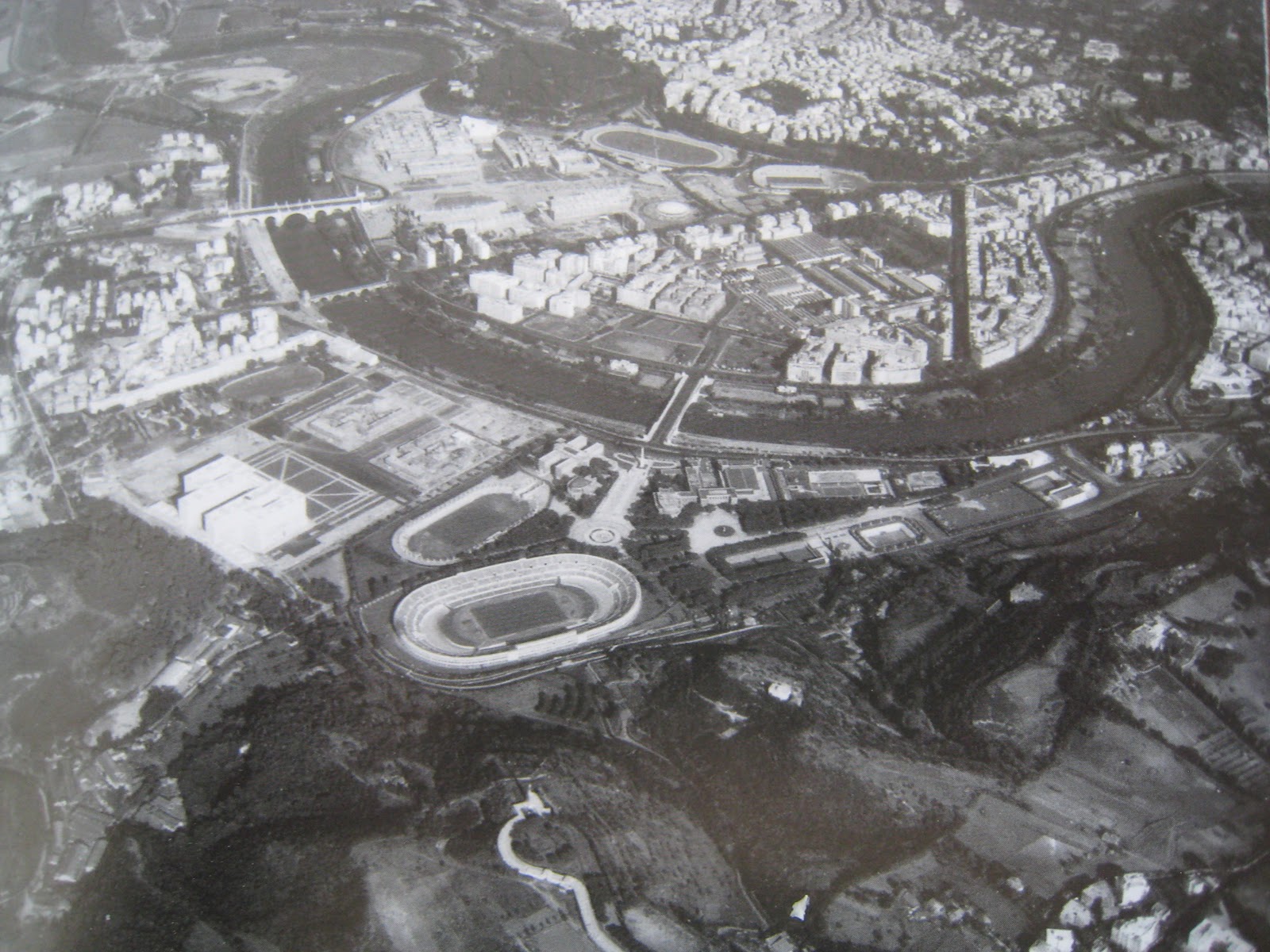
Fascism's legacy is everywhere in Rome.  But only in three places--EUR, to the south of the city; the University district, in central Rome; and the Foro Italico (originally called Foro Mussolini)--did the Fascists create the grand, monumental, architectural complexes intended to bring glory to the regime and the Duce and to illustrate dramatically Fascism's ideological commitments.  A city within a city, the Foro Italico complex was dedicated to youth, sports, and physical fitness--all Fascist obsessions.   The chief architect was Enrico Del Debbio, assisted by rationalist Luigi Moretti.  It opened in 1932 and comes in at #5 on the RST Top 40.  That it still exists owes something to the American soldiers who occupied the site after Rome was liberated in 1944.

We take readers of Rome the Second Time through Foro Italico at the end of Itinerary 9 (Monte Mario), as we come eastward toward the Tevere off Monte Mario.  To best appreciate the Foro on its own, we suggest an approach from Flaminio, over the Ponte Duca d'Aosta (itself an example of Fascist moderism, completed in 1939).  Here you'll see (or you won't see, if it's still shrouded for restoration), the most prominent symbol of the Foro and the Fascist regime: a 60-foot obelisk, known as "The Monolith," with the name MUSSOLINI prominently displayed.  To the left of the monument (if our memories serve us) is the Natatorium (pool building); if it's open for an event, or just plain open, wander in and have a look at the splended mosaics. 

To the right of The Monolith is an enormous building painted in Italian reddish pink: the Accademia di Educazione Fisica (Academy of Physical Education, also known as the "H Palace" for its figuration as seen from the air).  The Academy was originally painted in a brown red intended to evoke antiquity and to harmonize with the green background of Monte Mario (today mostly obscured--some would say tragically--by the remodeled sports stadium, where Rome's soccer teams play).  Further down the Lungotevere (you can go there first or after you've seen the rest of the complex) is the white marble facade of the Foresteria Sud (South Guest Quarters).  This building, too, was originally in rosso-bruno (brown red) but was redone very early on, in 1937, with a skin of white Carrara marble, apparently in order to put the building in sinc with Moretti's nearby Casa delle Armi, which housed the fencing academy.  Although today largely inaccessible, the Casa delle Armi is considered by some authorities to be the most important piece of architecture in the entire complex.  The elaborate open portico that once graced the rounded portion of the Foresteria is no more. 

Returning to the obelisk, continue directly beyond it to the Piazzale del'Impero (Grand Piazza of the Empire), an area favored more by skateboarders than tourists.  At your feet are an extraordinary set of mosaics by Gino Severini and other distinguished artists, each with a Fascist or imperial theme and many with a Fascist slogan, among them Mussolini's 1936 pat on the back, "Italy finally has its empire."  The piazzale's marble blocks, at 5' high a bit of a challenge for the skateboarders, commemorate what the Fascists remembered as their achievements: the March on Rome, the conquest of Ethiopia, and so on.  A few new ones added after the war, celebrate Fascism's fall and the emergence of a democratic state.  The piazzale was designed by Luigi Moretti.

At the end of the Piazzale lies the 42-ton Fountain of the Sphere (1933), transported to Rome from Carrara, and beyond it, two stadiums.  The larger of the two bears almost no resemblance to the original but may be of interest because it housed the track-and-field events of the 1960 Rome Olympics, an event we considered at length in an earlier post.  The better and more evocative work is the smaller stadium, the Stadio dei Marmi (Stadium of the Marbles), where the Olympic athletes stretched and warmed up for their events.  Today it looks very much as it did when it opened in 1932.  It's a lovely, complex work, subtle, elegant and remarkably simple in its basic configuration, monomental in the power of its statuary: 60 statues, each from and representing an Italian city, together a symbol of Italian unity, each alone a representation of the ideal Fascist body.  The Fascists were justifiably proud of this structure; the Hitler Youth appeared here when they came to Rome.

Above the trees and eastward off the far end of the Stadio dei Marmi is the Ministero degli Affari Esteri (Ministry of Foreign Affairs [1937-59], also known as La Farnesina).  Though not always part of the Foro Italico, it's worth a look if only because it won a design competition for building to house the Partito Nazionale Fascista (National Fascist Party).  It's by A. Foschini, V. Morpurgo and Del Debbio, and its massive look reflects the decline of rationalist modernism and the rise of a more monoumental architectural style, a development that followed upon Italy's increasingly bellicose foreign policy.  The huge piazza was intended to showcase enormous Fascist rallies (600,000 people) and was to include a memorial to "caduti fascisti" (fallen fascists).  A photo of building during construction in 1940 shows a more open, columned center entrance, though nothing sufficient to alleviate the heaviness of the structure.  The globe-like sculpture at the front left, with its "one world" vibe, is pretty cool.


A set of late-modernist structures toward the Tevere, designed as the International House of Students in the late 1950s, is today notable mostly for the extent of degradation.  Still, evocative.

Bill

Wednesday, May 4, 2011

Umbrian Spring: Following St. Francis and then some - Assisi to Spello hike

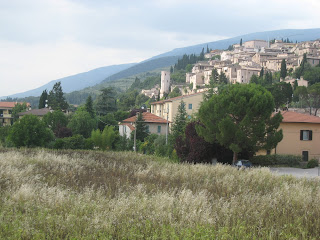
Looking back at Spello
Spring in Rome always makes us take to the hills. The itinerary described here is a wonderful round trip from Rome via train. And even better (I say) are the start and end points – the historical and beautiful Umbrian towns of Assisi and the lesser known Spello.
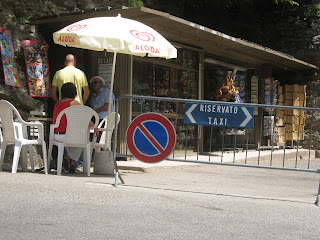
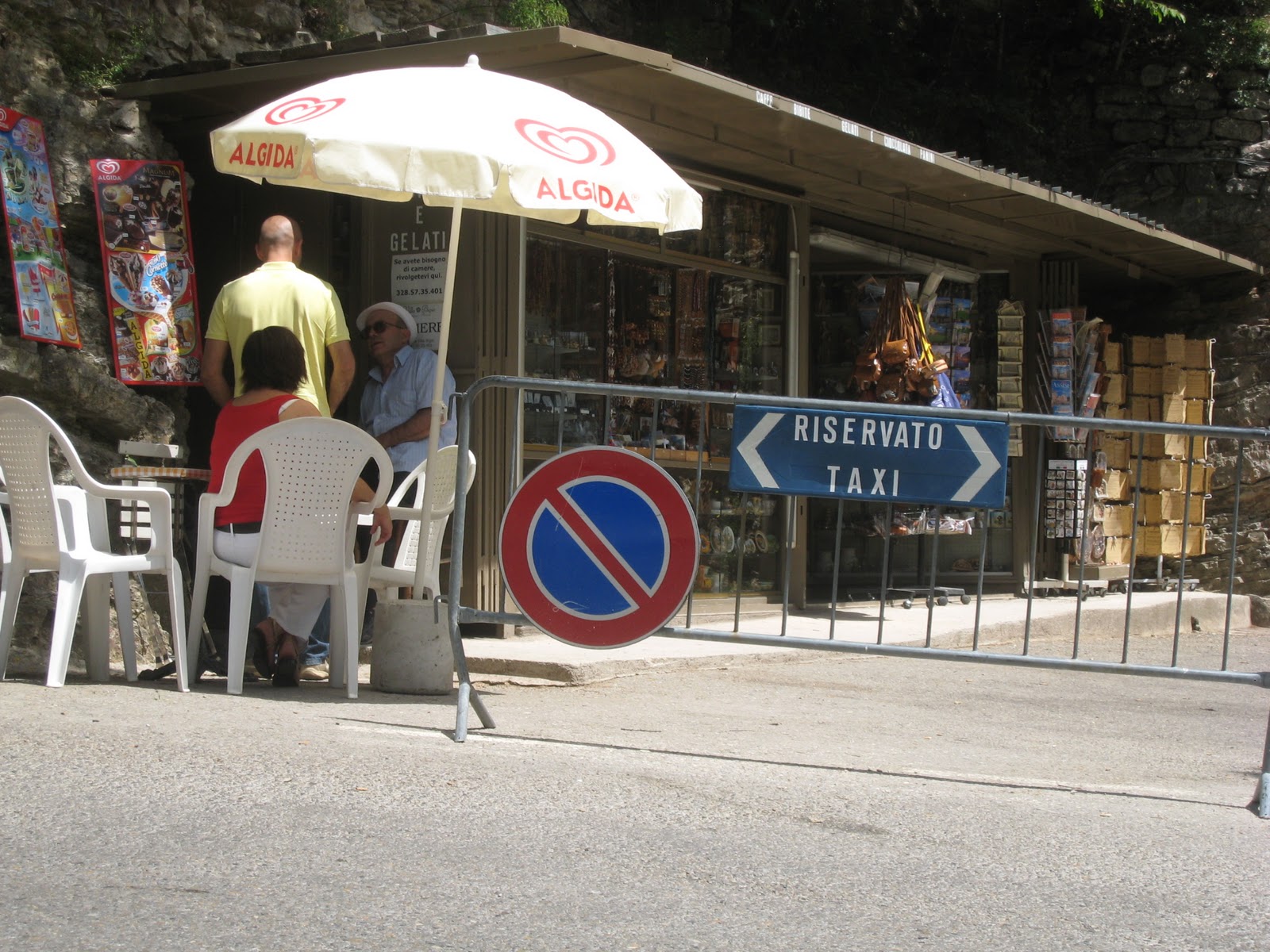
Not sure what St Francis would think of the tourist spot
his hermitage has become
We warn you the hike is not easy. The ascent is over 2600 feet – and, if you can’t imagine what that amounts to, you probably shouldn’t do this hike. It’s about 9 miles of hiking, the first part straight up for what seems like an hour (even if you take the bus from the train station to the top of Assisi). The total hike will take you 6 or 7 hours.
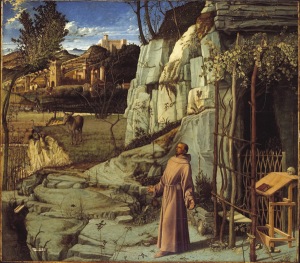
St Francis in the Desert, in the Frick Collection, NYC
That first steep pitch takes you to St. Francis’s hermitage, a frequented spot with a tiny church. You can walk through the carved-out rock and see his bed of stone. It’s remarkably like Bellini’s 1480 painting “St. Francis in the Desert” in the Frick Collection in NYC.  And, for an interesting take on this painting, with lots of detail, see this blog.

There’s a road leading up to the hermitage too; so you have to handle all those pilgrims who drive up and playfully skip around the hermitage, while you’ve just worn yourself out and want only to sit.
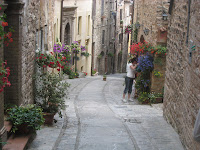
Signs of Spello's flower festival
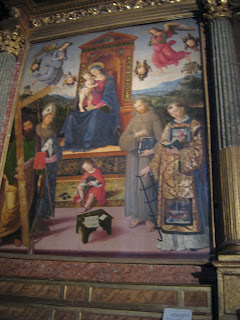
Pinturicchio painting in St. Andrea church
From the hermitage the path wanders past a refuge and to the top of the rather flat-topped Monte Subiaso. It’s blissfully downhill from there to charming Spello, which has an annual month-long flower festival and six (yes, six!) 12th-13th century churches.
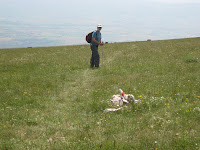
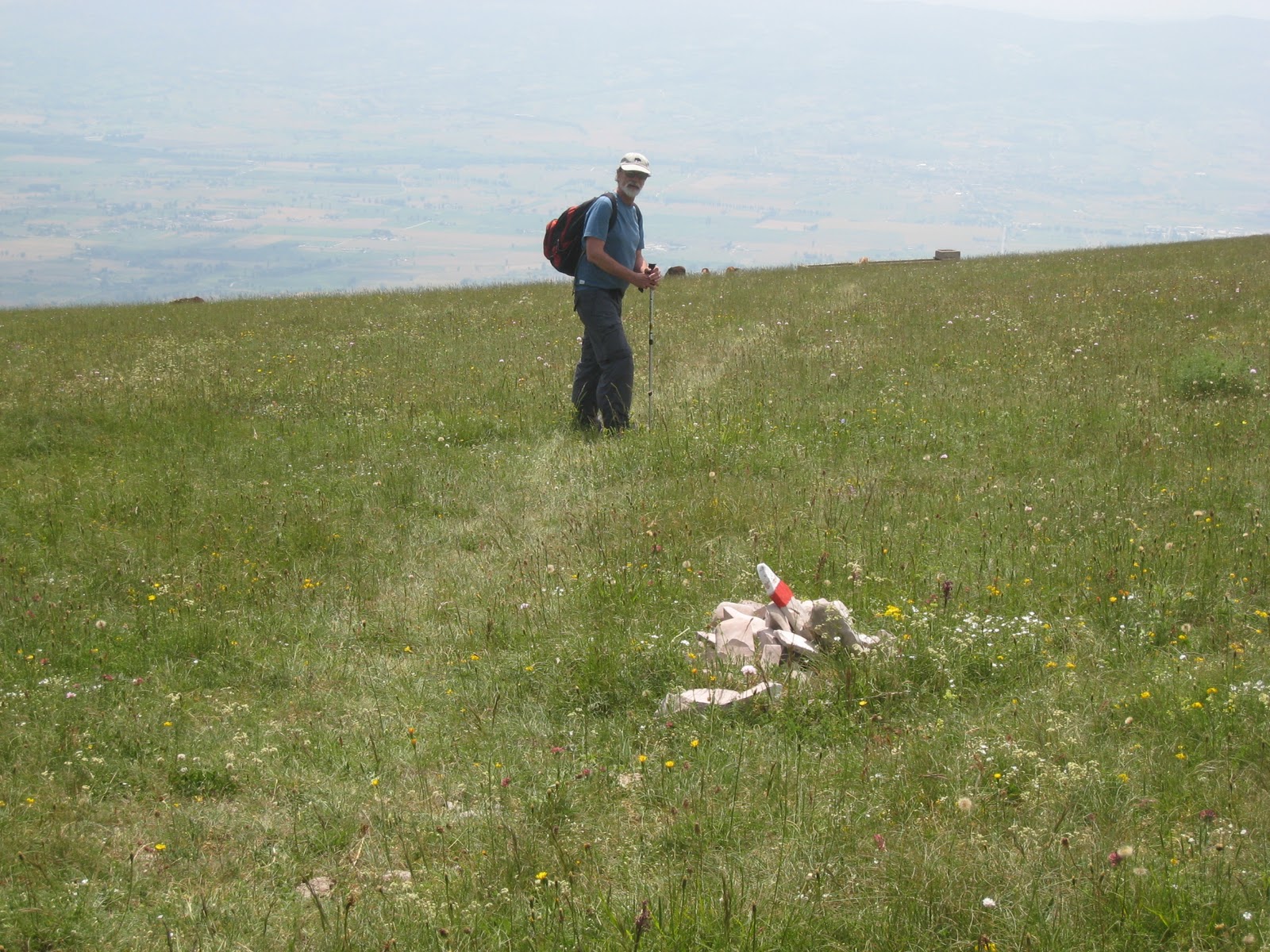
Trail markers leave a little to be desired
We found this hike in Gillian and John Souter’s Walking in Italy and we recommend you buy the book, because the markings and directions are not easy to follow without it, and even with it. This is quite an open hike and so best in Spring and Fall.

Buy a bottle of wine in Spello, splurge on a first-class ticket on the train (the differential isn’t much from here because the ride is only a little over 2 hours) and enjoy yourself on the way back to Rome.

Dianne